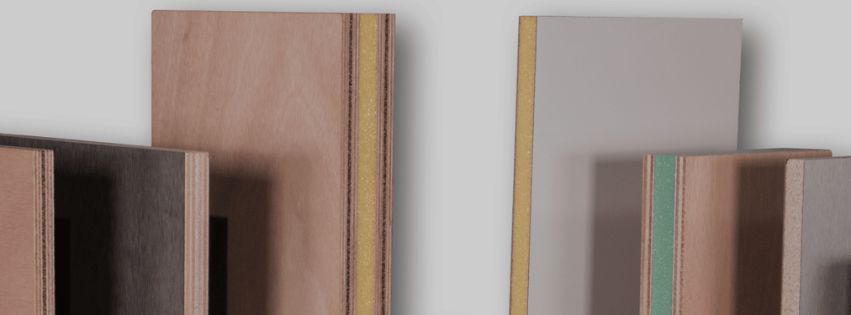
The growing attention to indoor air quality has led many professionals to ask whether a truly formaldehyde-free OSB exists and what the technical implications are when selecting this material.
It is important to clarify one point immediately: “formaldehyde-free” OSB does not exist in an absolute sense. However, there are OSB panels with very low emissions which, when properly coated and integrated into coherent construction systems, represent a technically and economically effective solution in many B2B contexts.
In this article, we analyse the topic with a technical and practical approach, focusing on coated OSB solutions, in particular OSB panels laminated with melamine paper, which are part of our production offering.
What is OSB (Oriented Strand Board)
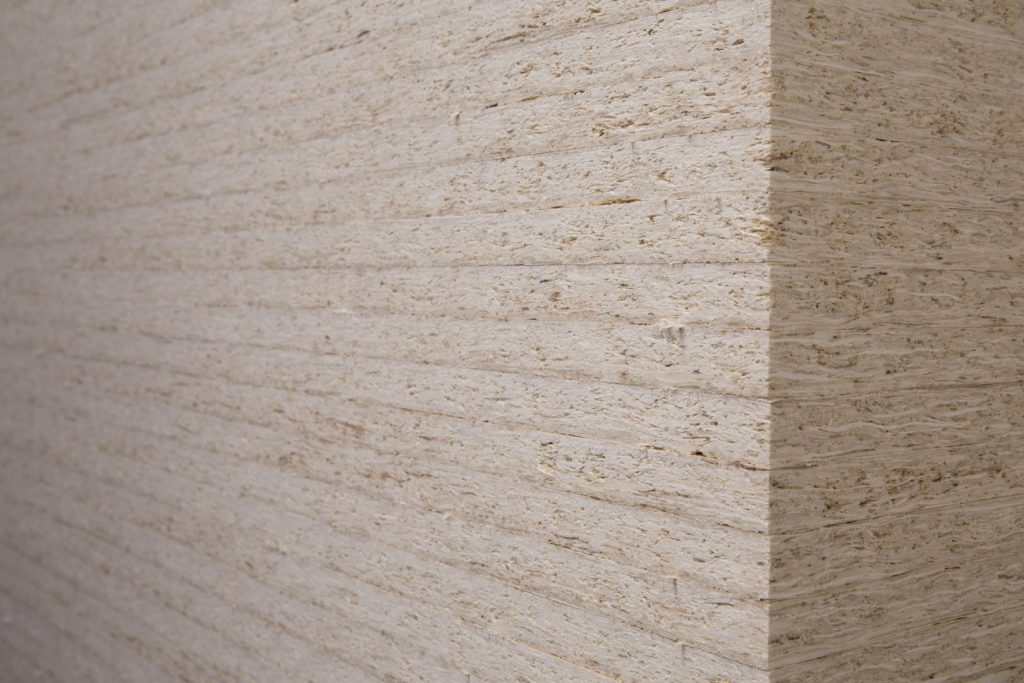
OSB (Oriented Strand Board) is a wood-based panel made of oriented strands, large in size and reduced in thickness, pressed and bonded together using thermosetting resins.
This structure gives the panel:
- excellent mechanical performance in relation to weight
- predictable behaviour under load
- good dimensional stability
The resins used are the main source of formaldehyde emissions, a substance naturally present in wood but which can increase during industrial processes.
OSB: composition of the raw panel and material behaviour
From a technical point of view, raw OSB has very interesting structural characteristics:
- oriented strands that improve bending strength
- high load-bearing capacity relative to thickness
- good workability for industrial applications
The OSB panels we use as a core material are manufactured with no added formaldehyde, using very low-emission resins, and are moisture-resistant according to class CL2 – EN 335, making them suitable for:
- humid interiors
- technical environments
- covered outdoor applications
However, it is essential to clarify that we do not market raw OSB panels, but coated OSB panels, designed for controlled end-use and in line with the needs of B2B customers.
Why formaldehyde-free OSB does not exist
Even the most advanced OSB panels release a minimal amount of formaldehyde, due to:
- the natural composition of wood
- the resins used in the manufacturing process
For this reason, when referring to formaldehyde-free OSB, what is actually meant are panels with very low emissions, certified according to recognised standards.
This is where an often underestimated element comes into play: the surface coating.
The value of coating: melamine-faced OSB
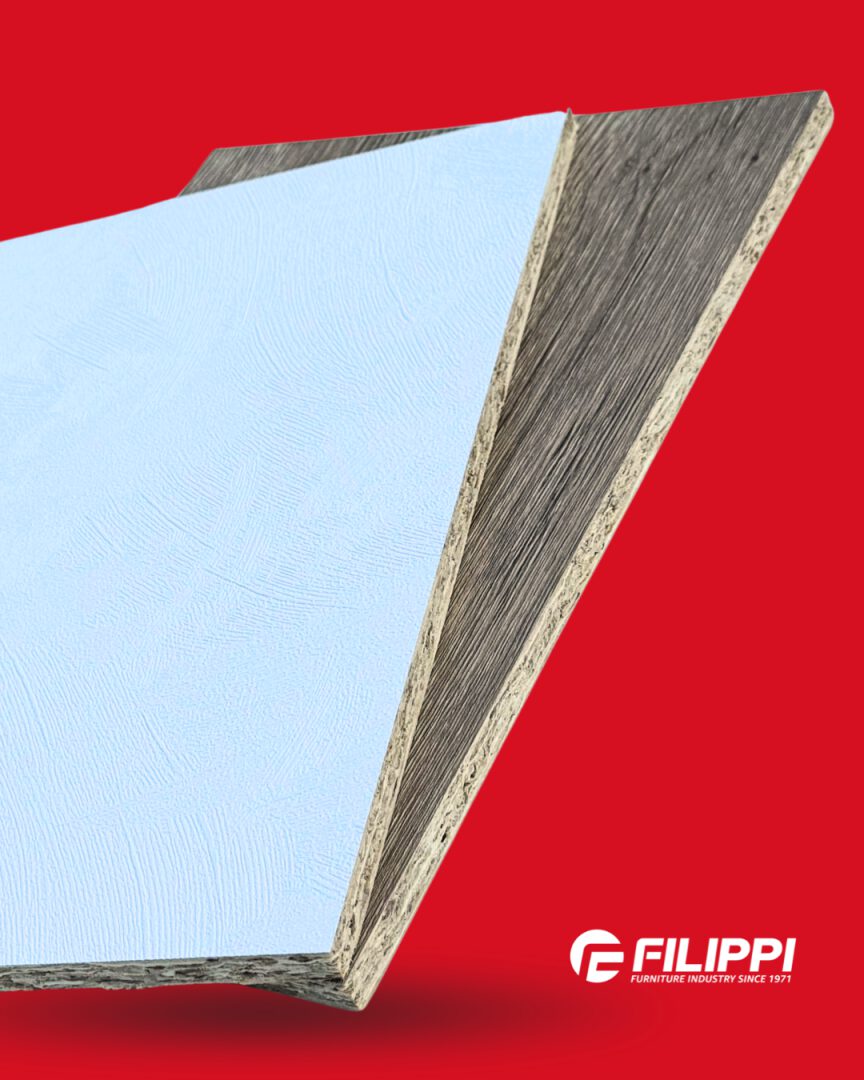
In our range, OSB is faced with melamine paper, transforming it from a raw structural panel into a finished technical product, ready for use in:
- structural components
- flooring
- technical furniture
- fittings and contract spaces
Melamine lamination performs several functions:
- improves surface resistance
- contributes to long-term stability
- reduces direct exposure of the core material
- allows more effective control of emissions in the finished system
Thanks to our in-house melamine panel production line, active since 2012, we are able to offer:
- aesthetically refined panels
- durable surfaces
- more competitive costs compared to plywood
Aesthetic customisation and surface coordination
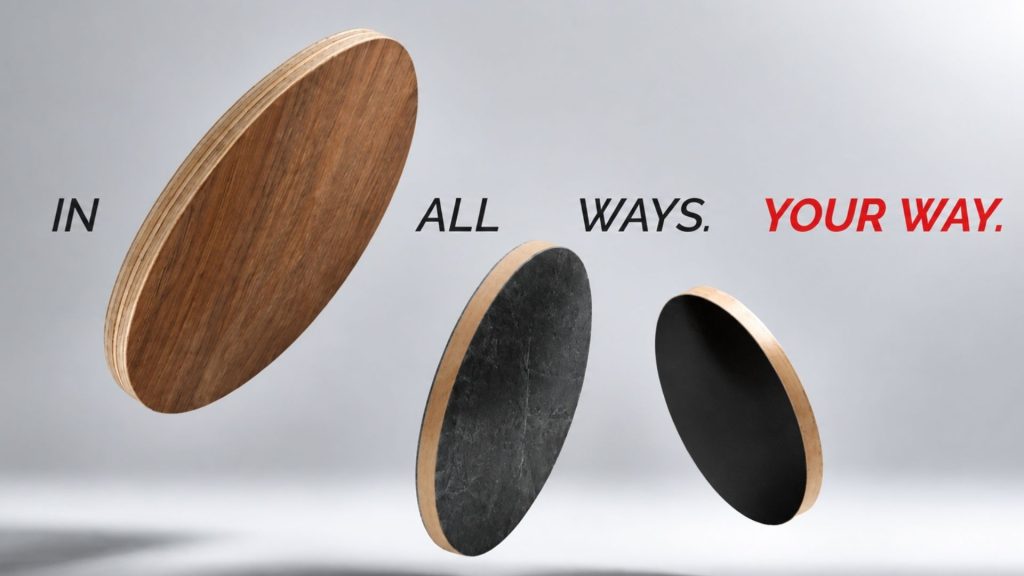
A further added value is surface customisation. Melamine-faced OSB panels can be:
- digitally printed with graphics and images
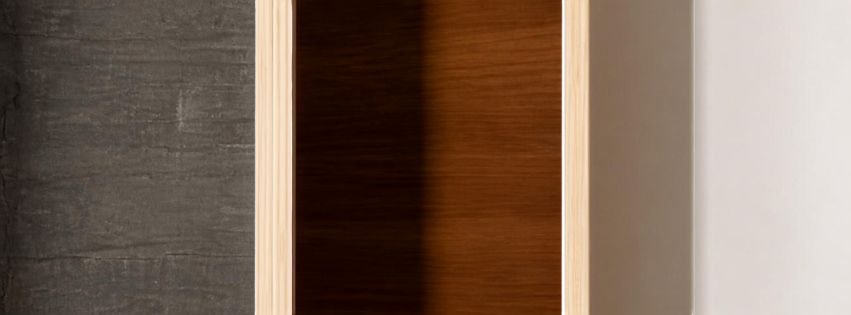
- coordinated with HPL laminate surfaces
Specifically:
- HPL laminates: suitable for vertical surfaces subject to higher wear
- melamine surfaces: ideal for horizontal areas or less stressed components
This approach makes it possible to design coherent, functional and visually uniform systems, while keeping weight, costs and performance under control.
Emission classes and OSB certifications
Emission classes
Formaldehyde emissions are assessed according to specific standards:
E1 – European standard
- compliant with EN 717-1
- suitable for use in indoor environments
E0 – Very low emissions
- not formally recognised across all of Europe
- indicates values lower than E1
CARB Phase 2 / EPA TSCA Title VI
- among the most stringent North American standards
- periodic inspections and production traceability
In the case of coated panels, it is essential to consider the emissions of the finished product, not only those of the raw core material.
OSB performance classes
EN 300 classes define structural performance:
- OSB/1: dry conditions, light loads
- OSB/2: dry conditions, higher loads
- OSB/3: humid environments, medium loads
- OSB/4: humid environments, heavy loads
These classifications remain valid even when the panel is coated, provided that processing complies with technical parameters.
How to correctly read a technical data sheet
To assess a coated OSB panel, it is necessary to consider:
- certified emission values (EN 717-1, CARB)
- type of surface coating and adhesives used
- reference standards and test methods
- supply chain traceability and batch identification
A complete technical data sheet ensures quality consistency, which is essential in serial production.
Why certification alone is not enough
Even a low-emission certified panel can lose effectiveness if:
- unsuitable adhesives are used
- the construction system is not coherent
- installation is incorrect
When properly integrated, melamine coating helps to:
- protect the core material
- stabilise the panel
- improve long-term performance
OSB, indoor air quality and B2B applications
Formaldehyde is classified as a VOC and must be controlled especially in:
- contract spaces
- technical furniture
- environments intended for prolonged use
Even when using low-emission panels, the following remain essential:
- adequate ventilation
- selection of compatible components
- system-level design as a whole
Maintenance and long-term behaviour
- Humidity and temperature: choosing the correct grade is essential
- Surface protection: coatings improve durability and stability
- Overall durability: excellent when the panel is used in the appropriate context
Alternatives to OSB in more demanding contexts
In applications where weight, precision or surface finish are priorities, the following may be considered:
- low-emission plywood
- lightweight sandwich panels
- HPL laminate surfaces
These solutions do not replace coated OSB, but complement it depending on project requirements.
Would you like to evaluate a coated OSB solution for your project?
We can support you in selecting the most suitable melamine-faced OSB panel, coordinating core material, coating and finish according to the final application.
FAQ
- Does truly formaldehyde-free OSB exist?
No. Panels with very low emissions exist, but not with zero emissions. - Do you sell raw OSB panels?
No. Our offering focuses on coated OSB panels, particularly melamine-faced OSB. - Does melamine reduce emissions?
It helps stabilise the system and reduce direct exposure of the core material. - Melamine-faced OSB or HPL?
Melamine for less stressed surfaces, HPL for areas subject to higher wear. - How are emissions certified?
According to EN 717-1, EN 13986, CARB and EPA TSCA standards, with periodic controls and full traceability.