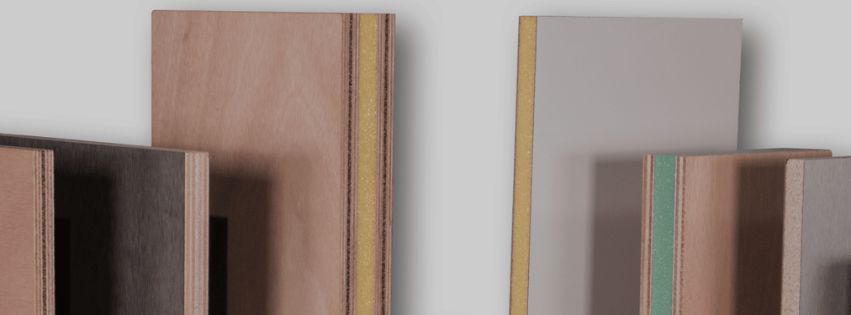
In yacht construction, shipbuilding and other outdoor environments with high technical requirements, the choice of wood-based materials cannot be based solely on aesthetic criteria.
Precise technical characteristics are required: moisture resistance, dimensional stability, lightness, workability and the possibility of customisation according to project specifications.
Marine wood, plywood for boats, plywood for shipbuilding and modern technical panels are becoming fundamental elements in interior fit-outs, partitions, furniture, coverings and components for marine environments.
It should be specified that, when referring to marine wood, this means all those wood-based materials designed to guarantee excellent performance even under conditions of humidity and variable exposure that characterise this field.
These include water-resistant laminated wood panels, okoumé plywood, plywood for boats and sandwich panels, where wood is combined with lightweight or functional core materials.
However, not all waterproof plywood panels are automatically suitable for every application in shipbuilding: the choice must always be calibrated according to the field of application, the expected load, the desired surface finish and the specific technical requirements.
Marine wood: what does it mean?
Going into more detail, the term marine wood does not indicate a single wood species, but rather a functional category of wood-based materials developed or selected for humid environments, exposed to salt air, temperature fluctuations and mechanical stresses.
Due to these characteristics, marine wood is often used in the naval sector and, in particular, on yachts, boats and marine cabins, for wall and ceiling coverings, furniture elements, partitions, technical panels and protected outdoor areas.
Depending on the project to be completed, it can be produced as conventional plywood, as an okoumé marine panel, as a technical panel or as a sandwich panel.
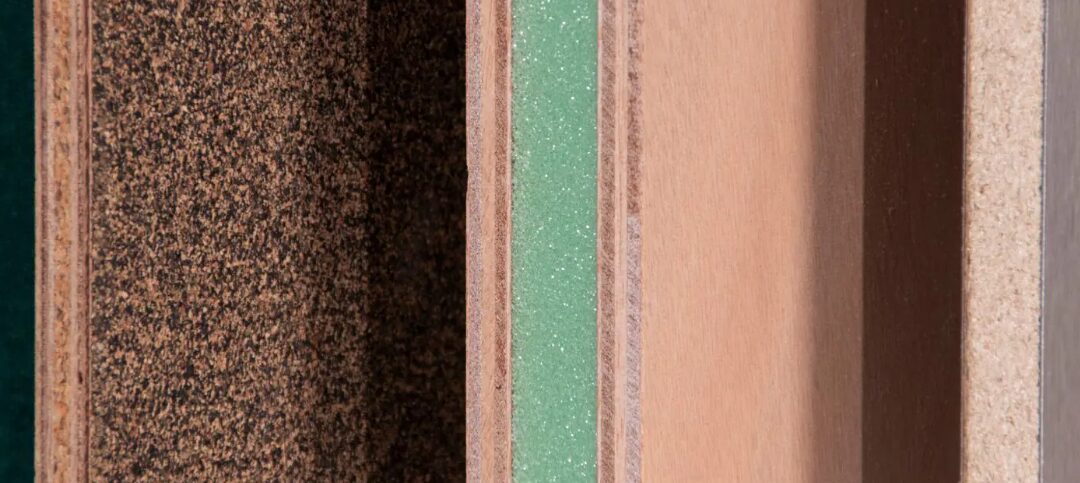
For professional use, it is not enough to evaluate only the wood species. Other elements must also be taken into consideration, such as bonding, panel structure, density, surface finish, edge processing and compatibility with other materials such as HPL, PVC, veneer, aluminium, cork, laminates, compact laminate materials or lightweight technical core materials.
Plywood for boats, plywood for shipbuilding and marine plywood: terms and fields of application
The terms “plywood for boats”, “plywood for shipbuilding” or “marine plywood” are incorrectly used as synonyms, referring to plywood panels intended for applications in boat and ship construction or in environments subject to humidity.
However, some distinctions need to be made.
Plywood for boats is generally associated with small boats, yachts, interior fit-outs and marine components. Plywood for shipbuilding, on the other hand, is used for industrial applications in the naval sector, where technical requirements, series production, stability and project specifications make the difference. Marine plywood, finally, refers to wood-based materials that can be used in marine environments.
What these materials have in common is the need for high dimensional stability and bonding suitable for the stresses of the marine environment.
Water-resistant plywood: not always synonymous with waterproof
When choosing plywood for boats, it should be remembered that water-resistant plywood is not automatically waterproof. “Water-resistant” generally refers to the quality of the bonding between the veneer layers, and this does not mean that the panel, without additional protection, can remain exposed for long periods to weather conditions, standing water or persistent humidity.
For marine applications, outdoor areas or humid environments, the surface treatment, edge sealing, installation conditions and intended use therefore also matter.
A panel for shipbuilding can only perform reliably over time if its structure, surface and processing are designed for the actual purpose for which it is intended.
In professional yacht and ship construction, therefore, the goal is not simply to find waterproof plywood, but a complete panel system adapted to the function of the structural element, the desired aesthetics, the stresses and the technical specifications of the project.
Why okoumé is among the most widely used woods in yacht construction
Okoumé is one of the best-known wood species in shipbuilding and plywood panels for boats. It is highly appreciated in boat interior fit-outs for its lightness, uniform grain and good workability. These characteristics make it the ideal material when the goal is to reduce weight without giving up a stable, high-quality wooden structure.
An okoumé panel for shipbuilding is used for coverings, furniture, partitions, panels and technical components. In more modern applications, it is often integrated into more complex panel structures: in sandwich panels, for example, okoumé is combined with lightweight or functional materials to provide additional insulation, stability, strength or weight reduction. The result is technical panels that can be adapted both to yacht and ship construction and to high-quality interior finishing projects.
The characteristics of a good marine panel
A marine panel must offer superior performance compared to a standard wood panel because, in this environment, wood is exposed to humidity, salt air, vibrations, temperature fluctuations and intense stresses.
Among the most important characteristics of a quality marine panel are moisture resistance, high dimensional stability, low weight, good mechanical strength, precise workability and a surface compatible with laminates, compact laminate materials, veneers, decorations or other technical finishes. Long-term reliability within the intended field of use is equally important.
For panels intended for yachts, interior coverings and technical components, processing quality must also be considered: clean edges, uniform structures and compatible surfaces facilitate subsequent processing and ensure integration into high-level interior finishing and shipbuilding projects.
The choice of a marine panel should therefore take into account the wood species, bonding, panel structure, surface characteristics, weight and expected stresses.
Wood for yachts and boats: selection criteria
When choosing wood for yachts and boats, moisture resistance is often the first criterion, but it is important to emphasise that this characteristic alone is not enough. Modern shipyards and interior designers require materials that can meet several requirements at the same time.
Among these, aesthetics play a decisive role: visible surfaces must have a high-quality appearance, integrate into the design concept and be combinable with different decors, veneers, laminates or compact laminate materials. At the same time, however, panels must remain lightweight, stable and durable.
For cabins, saloons, furniture, wall coverings and ceiling panels, every detail matters: weight, feel, surface, edge quality and ease of installation.
In shipbuilding, fire protection also matters, as do acoustic and thermal insulation, strength and industrial reproducibility: what is needed is not simply panels, but complete technical solutions.
This is also why sandwich and composite panels are becoming increasingly important, as they combine the natural quality of wood with other functional characteristics, allowing targeted adaptation to each field of application.
Applications of marine wood in yachts and boats
In yacht construction, these panels are used, among other applications, for interior coverings, furniture, cabinets, doors, partitions and internal compartmentalisation, ceiling panels, wall panels and decorative elements. Technical components and customised panels for yachts can also be developed using okoumé plywood or other suitable wood-based materials.
In shipbuilding, panel solutions are required for cabins, common areas, work areas, partitions, coverings and functional components. In this sector, in addition to aesthetics, performance, repeatability and technical reliability are of fundamental importance.
Yacht panels and technical panels: the importance of combining materials
Modern yacht panels are often no longer made from a single material. Instead, different layers and materials are combined to achieve the desired performance characteristics. A panel may, for example, feature an okoumé surface layer and be integrated with a lightweight core material, a decorative surface or a resistant technical surface.
These material combinations make it possible to create solutions that are lighter, more stable, more insulating or more resistant than conventional solid or standard panels.
Sandwich panels, laminates and compact laminate materials in marine interior fit-outs
In marine interior design, the combination of different materials is particularly important. Sandwich panels allow for a significant reduction in weight and, depending on their structure, can offer additional characteristics such as stability, insulation or improved handling. For yachts, boats and ships, this represents a decisive advantage, as reduced weight and reliable performance characteristics contribute directly to the quality of the project.
Laminates and compact laminate materials play an important role, especially for visible surfaces, furniture, wall coverings, doors and decorative elements. They can contribute to achieving the desired appearance, feel and resistance. Combined with suitable wood-based materials, they create panels that are perfectly aligned, both functionally and aesthetically, with high-quality marine interiors.
Depending on project requirements, composite fibre panels or other technical composite materials may also be suitable.
Filippi 1971: Technical panels for marine applications
Filippi 1971 develops and manufactures technical panels, sandwich panels, laminates and compact laminate materials, as well as customised solutions for sectors such as yacht construction, shipbuilding, the caravanning industry, the furniture industry and interior design. In the marine sector, the focus is on materials that combine lightness, stability, functionality and aesthetic quality.