
When it comes to lightweight construction in a recreational vehicle, it is not only a question of driving comfort.
For a camper OEM manufacturer or a caravan manufacturer, however, panel weight is first and foremost a specification: it affects the technically permissible maximum mass, the approved payload and the distribution of weight between the axles. It therefore needs to be managed from the vehicle design stage, rather than corrected later.
It is within this technical, rather than purely aesthetic, context that Filippi 1971 operates in the RV sector, supplying lightweight panels for professional outfitters and OEMs that need to meet precise specifications while maintaining the same quality standards from one production batch to the next.
Why panel weight is a design specification, not a detail
In a recreational vehicle, every kilogram of interior fit-out means one less kilogram of available payload for the end customer: water, luggage and accessories.
For an OEM, this means that the choice of panels for carcasses, furniture and interior coverings cannot be based solely on appearance and cost. It must form part of the overall vehicle weight calculation, together with the chassis, systems and technical components.
A lighter panel with the same performance provides greater design margins: more room for equipment, batteries, tanks or solar panels, without exceeding the maximum permissible mass at full load specified for vehicle approval.
Lightweight panels for series production requirements
Not all “lightweight” panels are equivalent from an OEM perspective: the choice depends on the function of the component and the production volumes involved.
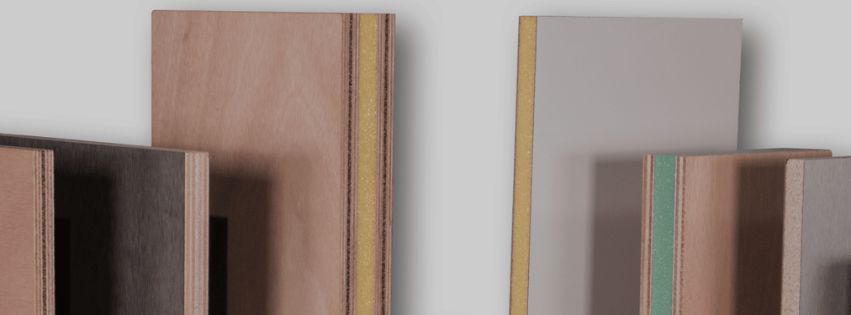
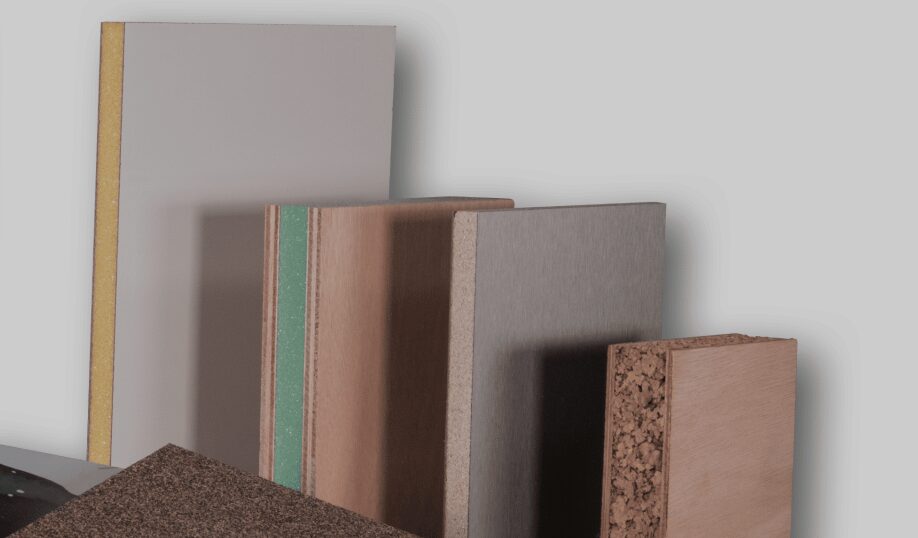
Poplar plywood. This is the most widely used starting material for structural carcasses in recreational vehicles: lightweight and resistant to impacts and stresses during driving, it is suitable for precise and repeatable CNC machining in large production volumes.
Sandwich panels. With a core in extruded or expanded polystyrene and poplar faces, they further reduce the weight of walls and ceilings compared with solid panels, while also providing a degree of thermal and acoustic insulation that contributes to onboard comfort.
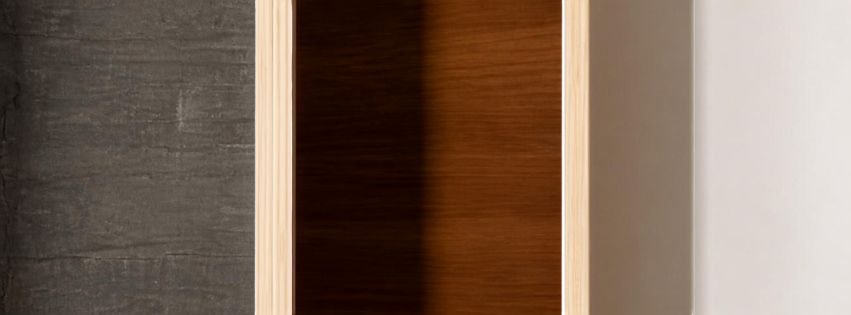
Laminated decorative panels. Lightweight poplar substrates covered with finish papers or decorative films are the solution for visible surfaces – furniture and interior panelling – where weight must remain low while the aesthetic result needs to be comparable to that of heavier materials.
Lightweight construction and moisture resistance: a balance to be defined in the specification
Reducing panel weight must not mean sacrificing strength and durability, especially in areas of the vehicle exposed to humidity and condensation, such as bathrooms, kitchens, shower columns and floor perimeter areas.
For these applications, a water-resistant lightweight panel for motorhome interiors – using an adhesive suitable for humid environments or a waterproof roll covering such as CPL, PET or PVC – makes it possible to keep the overall weight low without exposing the component to swelling, deformation or loss of resistance over time.
The choice between different substrate and covering combinations should be based on the area of the vehicle and the expected level of moisture exposure, rather than applying a single solution throughout the entire interior.
From the raw panel to the component ready for assembly on the production line
For an OEM manufacturer, the added value of a lightweight panel supplier goes beyond the raw material. Starting from the manufacturer’s drawings, Filippi 1971 produces finished components ready for assembly on the production line: cabinet doors, access doors, drawer fronts, sliding doors, furniture side panels, curved elements, bed extensions and kitchen and living-area components.
This allows the outfitter to receive components that already comply with the technical drawings, reducing additional processing at the plant and shortening assembly times.
What a camper OEM or caravan manufacturer evaluates when choosing a supplier
Those purchasing lightweight panels for significant production volumes look at different criteria than those involved in a single custom project:
- Repeatability of results from one production batch to the next, in terms of weight, thickness and finish
- Dimensional accuracy consistent with the project drawings
- Components ready for assembly, without additional processing on the production line
- Ability to support series production while maintaining consistent delivery times
- Possibility of calibrating weight and thickness according to the vehicle area and the function of the component
Regulations and certifications: an increasingly stringent requirement for OEMs
Filippi 1971 operates according to an ISO 9001 quality management system and selects materials compliant with REACH regulations on chemical substances. For the origin of the wood raw material, FSC®- and PEFC-certified products are available upon request and where applicable.
In terms of emissions, the E1 class is mandatory by law in Italy for all wood-based panels (Ministerial Decree of 10 October 2008), but the regulatory framework is becoming stricter: from 6 August 2026, a new European regulation halves the formaldehyde emission limit compared with the traditional E1 threshold.
In this context, Filippi 1971 also offers NAF (No Added Formaldehyde) panels and materials or zero-formaldehyde solutions, a requirement that motorhome OEMs are increasingly including in their supply specifications in preparation for regulatory compliance.
How Filippi 1971 supports camper OEMs and caravan manufacturers
For more than fifty years, Filippi 1971 has supplied panels and components for the motorhome, caravan and recreational vehicle sector, working both on the supply of finished panels for carcasses and interior coverings and on the production of finished components manufactured according to the manufacturer’s drawings.
For an OEM manufacturer or professional outfitter, this means having a single partner capable of following the project from selecting the lightest panel suited to the function through to the component ready for integration into the assembly line.