On board a yacht, every square metre counts twice: it must stand out for its design, but it must also meet precise technical requirements. Shipyards and interior contractors normally pay attention to details such as weight, fire and moisture resistance, but there is another aspect that is becoming increasingly important: acoustics.
In some cases, noise on board can seem louder than it actually is due to unsuitable materials and solutions. This is precisely where acoustic panels come into play: a targeted response to a challenge that has long been underestimated in yacht and boat interior fit-outs.
Acoustics in yacht interior fit-outs: an increasingly important detail
Modern yacht interiors are often characterised by large glazed surfaces, lacquered finishes, metal elements and compact environments that are technically dense. This combination encourages reverberation and makes even everyday noises, such as footsteps, conversations and the hum of technical systems, more noticeable.
This is not a secondary aspect to be pushed into the background: ensuring comfort on board also means ensuring a quiet environment. For this reason, yacht and boat interior designers are increasingly integrating the acoustic component already during the design phase, in order to avoid having to correct it at a later stage.
The importance of acoustic panels in shipbuilding and yacht interior fit-outs
When discussing technical specifications, however, one fundamental aspect must be considered: not all wood or decorative panels referred to as “acoustic panels” actually perform a verifiable sound-absorbing function. To understand whether a panel is genuinely capable of reducing noise, or whether it simply resembles an acoustic product aesthetically, it is necessary to analyse the core material, surface structure and installation conditions.
Sandwich panels, bulkheads and partitions: where acoustics concretely come into play in shipbuilding
In shipbuilding, it is primarily sandwich panels, bulkheads and partitions that determine the acoustic quality of an environment.
Core material and covering layers work together to define how sound travels between cabins and adjacent areas, and this is a detail that, when designing multi-cabin layouts or crew areas, directly affects the final result and customer satisfaction.
Even apparently purely decorative elements, such as wall coverings, ceiling panels and furniture fronts, can contribute to overall acoustic comfort if they are conceived from the outset as part of an integrated acoustic concept. A smooth decorative panel on its own absorbs very little sound; combined with a suitable substructure or an intermediate technical layer, it instead becomes a functional element of the interior environment.
Two product solutions, one acoustic result
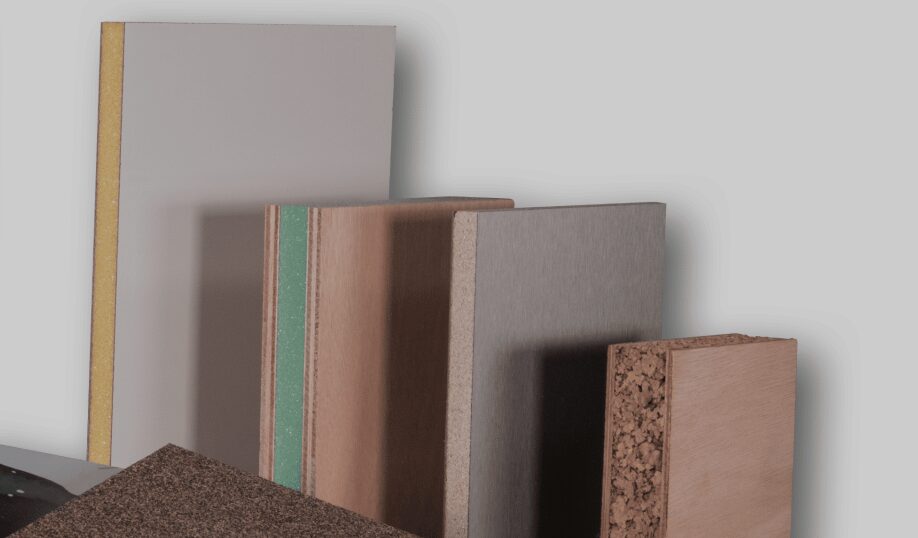
At Filippi 1971, two product lines in particular contribute to acoustic comfort on board: customised partitions and sandwich panels. The former are made from fire-retardant, water-repellent and sound-absorbing materials, specifically developed for load-bearing applications. The latter combine lightness, strength and acoustic insulation in a single component, and are suitable both for load-bearing elements and partitions. Acoustic comfort at Filippi 1971 therefore comes from targeted technical design based on these two established product lines.
Filippi 1971: customised components for shipyards and interior contractors
Filippi 1971 develops and manufactures coated panels, sandwich panels and customised components for the professional interior fit-out of yachts and boats. The range extends from wall coverings and ceiling elements to partitions and bulkheads, through to furniture elements — always calibrated to the requirements of shipyards, interior fit-out companies and yacht designers in terms of weight, stability, surface quality and, an increasingly requested characteristic, acoustic comfort.
Collaboration generally begins as early as the design phase: the earlier the acoustic requirements are defined, the more effectively the composition of materials and construction can be calibrated. This results in solutions that do not require acoustic “adaptation” at a later stage, but instead function from the outset as an integral part of the interior design.
New build or refit: acoustics must be considered at every stage
Whether it is a new build or the refit of an existing yacht, the right time to address acoustic issues varies considerably. In new builds, core material, wall structure and partition configuration can be calibrated from the outset according to the desired acoustic quality. In refits, on the other hand, shipyards and interior contractors often have to deal with room heights, cable routes and existing structures. In these cases, customised and reduced-thickness panel solutions make it possible to improve acoustic comfort at a later stage without radically altering the layout of the existing spaces.
Material selection as a strategic factor
The acoustic quality of a yacht interior is not the result of chance, but of a conscious choice of the right combination of materials. For shipyards, fit-out companies and designers, this means that acoustics must become part of the technical specifications alongside weight, fire resistance and surface finish. Filippi 1971 supports this process with panels and components that adapt flexibly to the requirements of each individual marine project, contributing over time to value and comfort on board.